
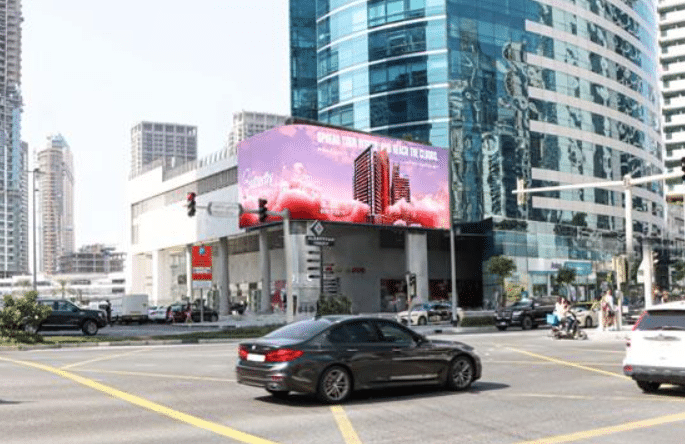
An outdoor LED screen has a harder job than any indoor display. It has to stay bright in direct sun, survive rain, dust and heat, and keep running day after day — on a building facade, beside a highway, over a stadium entrance or in a city square. Choosing the wrong one usually shows up fast: a screen that washes out at noon, a cabinet that leaks in the first storm, or a picture that looks coarse from where people actually stand.
This guide explains the seven things that decide whether an outdoor screen is right for your place, so you can judge a quote properly instead of comparing headline prices on screens built for very different jobs.
1. Start with where it will live, not with the screen
An outdoor screen is bought for a place: a roadside billboard, a building facade, a stadium scoreboard, a transport hub or a shopping centre entrance. Each place sets different demands — how far away people stand, whether the screen faces the sun, how high it sits, and what holds it up. Tell your supplier the place first: the address or type of location, whether it is a billboard, facade, stadium or public display, and whether it will run all day, every day. A supplier that quotes a screen without asking where it goes is guessing. The iOutdoor ECO Series, for example, is built for billboards, facades, stadiums, transportation hubs, retail facades and public information displays, for continuous 24/7 operation.
2. Brightness and sunlight
This is the first thing to get right outdoors. A screen that looks fine in a showroom can wash out completely in direct sun. Ask the supplier what brightness the display is built for, in nits, and whether it stays readable facing the sun — not just in shade. The iOutdoor ECO Series offers brightness from 5,500 to 10,000 nits (optional), for direct sunlight, roadside advertising, stadiums, transport hubs and building facades. The iVision O-Series, an outdoor fixed display for facades and roadside advertising, offers up to 5,500–7,500 nits. If your screen faces south or west into afternoon sun, say so — that decides the brightness you actually need.
3. Viewing distance and pixel pitch
Pixel pitch — the distance between the LEDs, in millimetres — decides how sharp the image looks from where people actually stand. A finer pitch is sharper up close and costs more; a coarser pitch is fine from far away and costs less. The right pitch matches your viewing distance, not the finest pitch in the catalogue. For the iOutdoor ECO Series the choice is P2.97, P3.91, P4.81, P6.25, P7.81 and P10.42: P2.97 and P3.91 for close viewing such as shopping malls, storefronts and transport hubs; P4.81 and P6.25 for commercial buildings and event venues; P7.81 and P10.42 for billboards and long-distance viewing. Tell your supplier how far the nearest viewer stands and how far the farthest one is, and let them match the pitch to it.
4. Weatherproofing — ask for the rating in writing
An outdoor screen lives outside all year, in rain, dust, humidity and heat. Ask how the cabinet is sealed, and ask for the weatherproof rating in writing, not just the word “weatherproof”. The iOutdoor ECO Series uses IP65-rated aluminium cabinets, sealed front and rear against rain, dust and humidity for reliable 24/7 operation, and carries CE, EMC, FCC and RoHS certifications. The iVision O-Series also carries IP65 protection. Check what the rating covers — front only, or front and rear — and what it means for where your screen sits: a facade screen and a ground-level screen face different weather.
5. Size, cabinet and structure
Outdoor screens are built from cabinets joined into a wall, so the cabinet decides how the screen is installed and held up. Ask the cabinet size and weight, whether sizes can be customised, and what structure it mounts on — wall, steel structure, pole, rooftop or a custom frame. The iOutdoor ECO Series uses a lightweight aluminium cabinet, 960 × 960 × 83 mm and 22.5 kg, with custom widths up to 1500 mm and heights of 500 mm or 750 mm, for wall mounting, steel structures, pole mounting, rooftop and custom outdoor installations. A lighter cabinet means less structural load on a facade or rooftop — worth asking about before the steelwork is priced, not after.
6. Power and running costs
An outdoor screen runs for long hours, often around the clock, so power use is a real running cost, not a footnote. Ask for typical power consumption, not just the maximum, and what voltage it runs on. The iOutdoor ECO Series runs on AC 90–264V, 50/60Hz, with typical power consumption of 100–200 W/m² and maximum of about 650 W/m². Ask how that typical figure was measured — a screen that is bright enough at lower power is cheaper to run for years, and that saving is part of the price comparison.
7. Service, spares and downtime
A billboard or facade screen cannot wait a week for a spare part while it sits dark in front of thousands of people. Ask how a damaged module is replaced, whether the cabinet can be serviced from the front, the rear, or both, and what spare modules and after-sales support are included. The iOutdoor ECO Series supports both front and rear service access, which cuts maintenance time and installation cost. Ask about spare modules, lead time and after-sales support in the quote, in writing — the same way you would ask about brightness and the weatherproof rating.
What a fair quote should include
Before you accept a price, ask the supplier to confirm these seven things in writing:
- the location and use, and the screen size and cabinet layout;
- the brightness, in nits, and whether it suits direct sun;
- the pixel pitch and why it fits your viewing distance;
- the weatherproof rating and what it covers;
- the cabinet size and weight, and the mounting structure;
- typical power consumption and the voltage;
- what service access, spare modules and after-sales support are included.
A quote that answers all seven is comparable. A quote that answers only the price is not.
How to get a quote from ILEDScreen
ILEDScreen is an OEM manufacturer of LED displays in Shenzhen, China, founded in 2019. Its outdoor fixed lines include the iOutdoor ECO Series for billboards, facades, stadiums and transport hubs, and the iVision O-Series for permanent outdoor installations such as building facades and roadside advertising. Outdoor displays from ILEDScreen are trusted in more than 30 countries.
For a factory-direct quote, send your screen size, installation location, viewing distance and application through the contact page or the iOutdoor ECO product page. Every inquiry is reviewed by a technical sales specialist and answered with a complete solution — cabinet layout, LED configuration, controller recommendation, structural advice and a detailed quotation — within one business day.
Frequently asked questions
How bright should an outdoor LED screen be?
Bright enough to stay readable in direct sun at your location. As a guide, the iOutdoor ECO Series offers 5,500 to 10,000 nits; a screen facing into afternoon sun needs the higher end. Ask the supplier for the brightness in nits, not just “high brightness”.
What pixel pitch do I need outdoors?
Choose by viewing distance. Close viewing in a mall or transport hub calls for a fine pitch such as P2.97 or P3.91; a roadside billboard seen from far away is fine with P7.81 or P10.42.
Does an outdoor screen need to be weatherproof?
Yes — it lives outside all year. Ask for the weatherproof rating in writing: the iOutdoor ECO Series is IP65-rated front and rear.
How much power does an outdoor LED screen use?
It depends on size and brightness. The iOutdoor ECO Series typically uses 100–200 W/m², with a maximum of about 650 W/m². Ask for the typical figure for your screen size, so you can compare running costs.