
An LED display is not a commodity you can return easily. It is a large order, often custom-sized, shipped across the world and then expected to run for years in public. The manufacturer you pick matters more than the pixel pitch you pick — a good screen from a manufacturer who disappears after the sale is a bad buy.
1. Start with what you actually need — then check they make it
Before comparing manufacturers, fix the job: a poster display for a shop window, a perimeter screen for a stadium, an outdoor billboard, an indoor video wall, a rental fleet, a transparent storefront screen, a taxi-top display, or a shelf display. Each one is a different product, and a manufacturer that is strong in one can be weak in another.
ILEDScreen builds all of these — poster (iPoster), stadium perimeter (iArena), outdoor (iOutdoor ECO), indoor video walls (iPrime, iVision Aluminum and iVision Steel), rental (iStaging R Series), transparent (iTransparent and iFilm), taxi-top (Sparkon TaxiTop) and shelf displays (iMini Shelf COB). The point is not the list — it is the test. Ask any manufacturer to show you the exact product family you need, with its own page, its own specs and its own past installations. If they can only show you a different product and promise yours will be “similar”, keep looking.
2. Check it is a real factory, not a trading company
A trading company can quote you a screen. It cannot build one, fix one, or change one. Before you send a deposit, establish that the manufacturer actually manufactures.
The facts to ask for are simple and checkable: where the factory is, how big it is, how long it has operated, and how many people work there. ILEDScreen is an OEM manufacturer based in Shenzhen, China, founded in 2019, operating a roughly 2,500 sqm factory with a team of around 20 people. Those are the kinds of facts a real factory states plainly — on its about page, in its emails, on its profiles — because they are easy to verify. Ask for a factory photo or a short video call from the production floor. A real manufacturer says yes without hesitation; a middleman finds a reason to say no.
3. Get the real specifications in writing — for your exact model
A serious manufacturer publishes real numbers for the exact model you are buying, and puts them in writing on the quote. The numbers that matter depend on the job, but the pattern is the same: pixel pitch for your viewing distance, brightness for your light conditions, protection rating for outdoor use, cabinet size and weight, and refresh rate if the screen will be filmed.
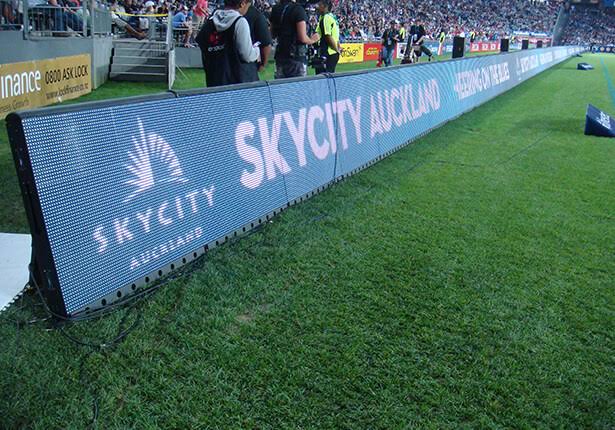
Take the stadium example: the iArena series publishes IP65 cabinets, brightness up to 10,000 nits and pitches from P3.1 to P10 — numbers you can check against the installation. The iTransparent series publishes 60%+ transparency and 4500+ nits at P3.91 / P7.82. The rental iStaging R Series publishes its cabinet sizes (500×500 / 500×1000) and pitch range (P2.6–P4.81). If a manufacturer quotes you a screen without these numbers — or quotes numbers for a different model in the range — ask again, in writing, for the numbers of the configuration you are actually buying. “High brightness” and “good quality” are not specifications.
4. Ask for the certifications your market requires
Certifications are not decoration. They decide whether the screen can legally be sold and installed in your country, and whether your client will accept it. ILEDScreen products are CE and RoHS certified, and the company’s own materials list CE-EMC, LVD, FCC and ISO 9001.
Ask for the certificate documents for the exact model and configuration before you pay a deposit — not a certificate for a different product, and not a promise that one “can be provided”. Keep the documents with the order. If your market needs a specific local approval on top of CE — ask about that by name before ordering, not after the screens arrive.
5. Check they can build it your way — OEM, not off the shelf
Most LED display orders are not standard. The size, the pitch, the cabinet, the mounting and the content system all change with the project. A manufacturer earns the name when it can adapt the product to the job, not when it can only sell what is already on the shelf.
Sparkon TaxiTop is a clear example of what to look for: dimensions, pixel pitch, brightness, cabinet structure and mounting design are all customized to the project rather than sold as one fixed box. Ask your manufacturer the same question for your job: what can change, what cannot, and what does the change cost in price and in lead time. Get the answer on the quote, not in a chat message you cannot find later.
6. Ask what happens after the sale — support, spares and service
A display that runs for years needs a manufacturer that is still there in year two. Before ordering, ask three questions and get the answers in writing: who do you contact when a module fails, what spare parts are included or available and how fast do they ship, and who pays for what if a cabinet arrives damaged or a module dies early.
Also ask how the screen is serviced — front service or rear service matters a lot when the display is mounted flat against a wall. A manufacturer that answers these questions plainly, with names and timeframes, is one that has supported real installations. A manufacturer that only talks about the sale price is telling you what happens after the sale.
7. Compare written quotes, like for like — then decide
Get the quote in writing, with the same details from every manufacturer you compare: exact model and configuration, size and quantity, pixel pitch, brightness and protection rating, cabinet size, certifications included, spare parts, warranty terms, lead time and shipping terms. A quote that leaves half of these out is not cheaper — it is incomplete, and the missing items arrive later as extra charges or delays.
Do not choose on price alone. A screen that is 10% cheaper and fails in its first summer costs far more than the saving. Choose the manufacturer whose factory you could verify, whose specs you could check, whose certificates you could hold, and whose support you could reach — and then let the written quote confirm the price.
A short checklist before you choose a manufacturer
- Product family: do they actually make the type you need
- Factory: location, size, years in business, team — verifiable
- Specifications in writing for your exact model and configuration
- Certifications for your market, documents for the exact model
- OEM / custom ability: what can change, and at what cost
- After-sales: contact, spares, service access, warranty terms
- Written quote, like for like, with lead time and shipping terms
Send those answers with your sizes, quantities and installation details, and a real factory can quote the right display the first time. Start from the product range and the company behind it: ILEDScreen products, About ILEDScreen — or contact ILEDScreen for a quote.