
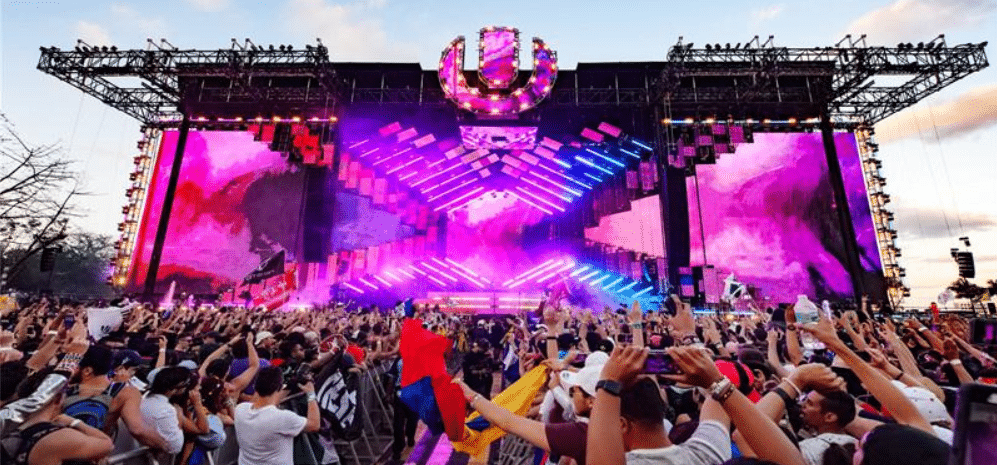
A rental LED display lives a different life from a fixed wall. It is loaded in a truck on Friday, built on Saturday, taken down on Sunday and shipped to the next city on Monday. What decides whether it earns its keep is not only how it looks on stage — it is how fast it goes up, how light it is to carry, and how it survives the next ten shows.
1. Start with viewing distance, not screen size
Pixel pitch is the distance between pixels, and it sets how close the audience can stand before the picture breaks into dots. A corporate event where the front row sits a few metres away needs a finer pitch than a festival stage viewed from fifty metres.
As a rule of thumb, the finer the pitch, the closer the comfortable viewing distance. The iStaging R Series covers P2.6, P2.97, P3.91 and P4.81, so the same rental stock can serve a close-up indoor stage at P2.6 and a large outdoor crowd at P3.91 or P4.81. Tell your supplier the nearest and farthest viewing distances first, and let the pitch follow from that, not from a catalogue default.
2. Check cabinet size and weight — your crew will feel it
Rental cabinets are lifted, stacked and flown dozens of times a year. Two things decide how much that costs you: the cabinet size and the weight per cabinet. The iStaging R Series comes in 500×500mm and 500×1000mm cabinets, weighing 8 kg and 14.5 kg — light enough for a small crew to handle, and the larger cabinet covers more area per lift on a big wall.
Before you buy, ask how many cabinets fit in your truck and your flight cases, and how many people a wall of your usual size needs to build. A lighter cabinet is not a luxury in rental — it is fewer crew hours on every single job.
3. Fast setup is the whole business
A rental wall is paid for by the day, and setup time comes out of that day. Look for fast-locking systems and tool-free connections: cabinets that lock together quickly, align themselves and need no fiddly adjustment on site. The iStaging R Series is built around fast installation and fast-locking systems for exactly this reason.
When you compare quotes, ask how long a 20-square-metre wall takes two people to build — and how long it takes to take down and pack. A wall that builds in half the time can do twice the jobs in a season.
4. Indoor and outdoor are two different jobs
Some rental stock only ever works indoors. Some has to survive rain, dust and direct sun. The iStaging R Series is built for indoor and outdoor events, which is what a rental house needs when the same stock goes from a conference hall one week to a festival field the next.
For outdoor work, ask two questions before you buy: what weatherproof rating does the cabinet carry, and is it bright enough to read in daylight? Do not take a rating from a different product line — ask for the rating of the exact cabinet you are buying, in writing.
5. Refresh rate matters if cameras are involved
At a concert or corporate event the screen has to look good to the people in the room — and often through a camera as well. A low refresh rate can flicker or show banding on camera even when it looks fine to the eye, and that ruins the recording of an event that cannot be repeated.
If your wall will ever be filmed or broadcast, put refresh rate on the checklist before you order, and ask the supplier for the figure for your exact pitch. Do not assume it from another series.
6. Plan for the shape of the job, not just a flat wall
Rental work is rarely one flat rectangle. One week it is a straight stage backdrop, the next a wide exhibition wall, the next a ground-stacked screen in a venue with no rigging points. Ask what configurations the system supports — hanging, ground stacking, different wall sizes from the same stock — and whether the same cabinets can build all of them. Flexible configurations, as on the iStaging R Series, mean one stock list covers more kinds of jobs.
If your design has any curve, corner or unusual shape, say so in the first message: it changes the cabinet, the accessories and the quote.
7. Spares and service decide whether a show goes on
In rental, a dead module on show day is not an inconvenience — it is a show that does not happen. Before ordering, ask three questions: are spare modules and power supplies available, can they be swapped quickly on site, and how fast can replacements be shipped? A rental house should also ask whether the supplier keeps the same series in production, so next year’s purchase still matches this year’s stock.
A short checklist before you ask for a quote
- Nearest and farthest viewing distances, and indoor, outdoor or both
- Usual wall sizes, and whether you hang, ground-stack or both
- How fast the wall must go up, and how many crew you have
- Whether the wall will be filmed or broadcast
- How many shows a year the stock will do, and where it travels
Send those five answers with your size and application, and a factory can quote the right pitch, cabinet and configuration the first time — instead of revising it three times. ILEDScreen builds rental LED displays factory-direct from Shenzhen, in the iStaging R Series, for concerts, festivals, exhibitions, corporate events and touring productions, all CE and RoHS certified. Contact ILEDScreen for a quote — or start from the product page: the iStaging R Series.