
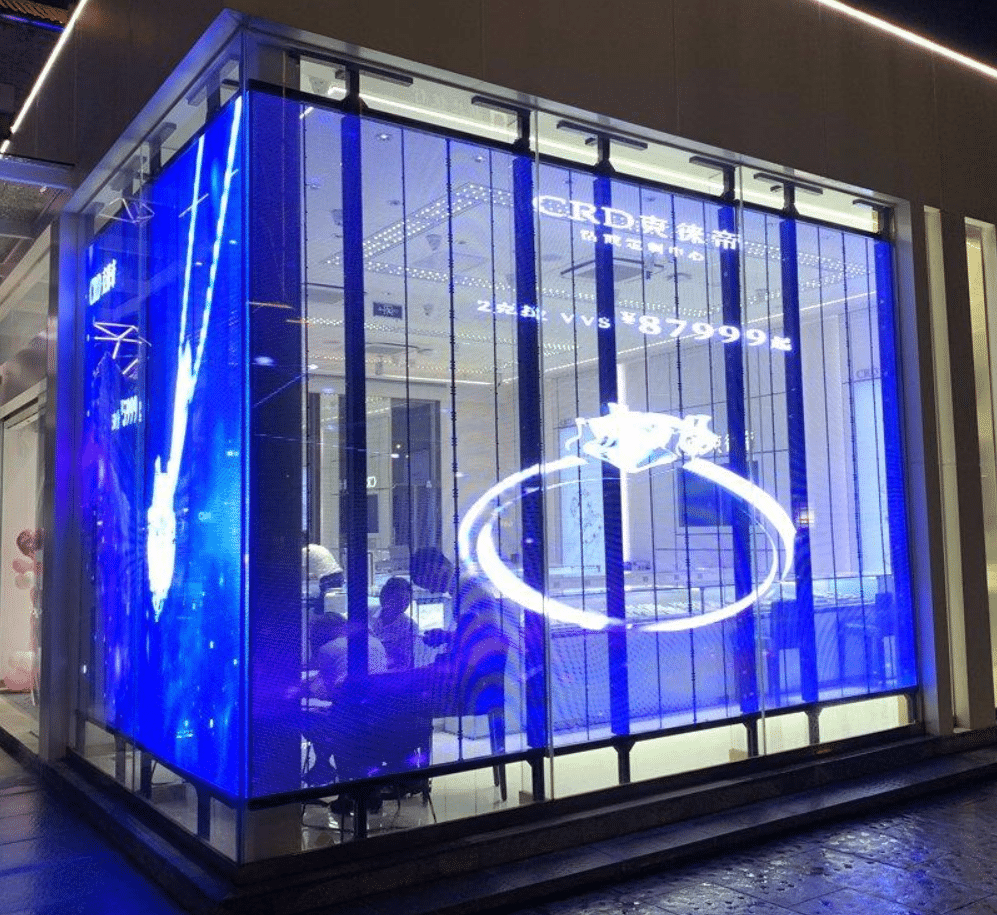
A transparent LED display has to do two jobs at once: show a bright, clear picture — and disappear when the picture is off. Put it behind a shop window and it must sell the product without hiding the shop. Put it on a glass façade and it must advertise without turning the building dark inside. That trade-off is what decides a good buy, and it is different from choosing an ordinary video wall.
1. Start with transparency — and what it costs in brightness
Transparency is the share of the glass that still lets light through. The iTransparent Series keeps over 60% transparency, which preserves natural light and visibility into the store or building. The iFilm Series goes further, up to 95% transparency, because it is a thin film stuck straight onto the glass rather than a cabinet in front of it.
Higher transparency usually means fewer LEDs per square metre, so ask what brightness you get for it. A display that is 95% transparent but too dim to read in daylight has failed at the first job. The iTransparent Series pairs its 60%+ transparency with 4500+ nits of brightness, which is what makes it readable on a sunlit façade. For any transparent display, ask for both figures together — transparency and brightness — never one without the other.
2. Match pixel pitch to viewing distance
Pixel pitch sets how close a viewer can stand before the picture breaks into dots. For a storefront window seen from the pavement a few metres away, you need a finer pitch than for a tower façade seen from across the street.
The iTransparent Series comes in P3.91 and P7.82: P3.91 for storefront windows, shopping malls and close viewing, P7.82 for large glass façades and long-distance outdoor advertising. The iFilm Series covers P5 to P20, with the finer pitches for close-up glass and the larger ones for big façades viewed from far away. Tell your supplier the nearest and farthest viewing distances first, and let the pitch follow from that.
3. Cabinet or film — pick the one your building allows
This is the choice that decides the whole installation. A cabinet display like the iTransparent Series uses 500×1000mm die-cast aluminum cabinets, mounted on the wall, hung, or fixed to a steel structure. It suits new façades and large installations where a structure is already planned.
A film display like the iFilm Series is self-adhesive: it sticks directly onto existing glass, with no steel structure and no heavy cabinets, and the 1000×240mm film modules can be cut to fit the glass you already have. It suits a shop or office that cannot rebuild its façade, a listed building, or a rented space where the glass must stay as it is. Before you choose, check with your landlord or building manager what you are allowed to fix to the glass — that answer often makes the decision for you.
4. Indoor and outdoor are two different jobs
A storefront window faces the street, the sun and the weather, even though it sits behind glass. The iTransparent Series is built for outdoor use, with IP65 protection and 4500+ nits brightness, so it holds up on a façade and in direct sunlight.
Do not assume the same of a film display: no weatherproof rating is published for the iFilm Series, and it is made for existing glass indoors and in sheltered positions. If your screen will face rain or full sun, ask for the rating of the exact product you are buying, in writing — and do not take a rating from a different product line.
5. Check power and control before you order
A transparent display runs all day in a shop window, so running costs matter as much as the purchase price. The iTransparent Series averages 400 W/m² (800 W/m² maximum) on AC 220V. The iFilm Series runs on DC 5V and works with NovaStar and Colorlight control systems — if your building already runs one of those, say so in the first message, because it changes the controller and the quote.
Ask how the content is played and updated as well: who changes the advert, how often, and from where. A screen nobody can update quickly is a screen showing last month’s promotion.
6. Plan for servicing a screen you cannot take down easily
A façade display cannot be carried into a workshop. Ask how a dead module is replaced on site, and how long the screen is dark while it happens. The iTransparent Series uses modular 500×125mm units so a section can be serviced and replaced with minimal downtime — ask any supplier the same question about their own system, and get the answer before you order.
Also ask whether the supplier keeps the same series in production, so a panel bought next year still matches the one you install today.
7. Think about what the glass looks like when the screen is off
This is the question buyers forget, and the one their customers notice first. When the display is off, does the shop still look open? Does the office still get daylight? A good transparent display disappears into the glass; a bad one leaves a grey grid across the window all day. Ask for a photo of the exact product installed and switched off, not only a bright render with the screen on.
A short checklist before you ask for a quote
- Glass size and type, and whether it is a storefront, curtain wall or interior partition
- Nearest and farthest viewing distances, and indoor, outdoor or both
- Whether a steel structure is allowed, or the film must stick to existing glass
- Transparency and brightness you need, together — not one alone
- Power supply available, and which control system you already use
- Who updates the content, and how often
Send those six answers with your size and application, and a factory can quote the right pitch, format and configuration the first time — instead of revising it three times. ILEDScreen builds transparent LED displays factory-direct from Shenzhen, in the iTransparent Series for glass façades and storefronts and the iFilm Series for existing glass, all CE and RoHS certified. Contact ILEDScreen for a quote — or start from the product pages: the iTransparent Series and the iFilm Series.