
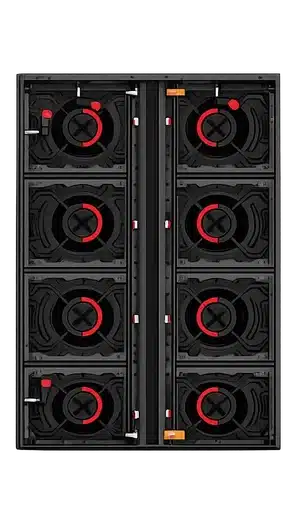
A stadium perimeter LED display is the long, low advertising board that runs around the edge of the pitch — the sideline screen fans see behind the players and TV cameras see behind every goal. It is not a normal outdoor billboard turned sideways: it has to survive a stadium, look right on broadcast, and keep selling advertising space match after match.
This guide explains the six things that decide whether a perimeter display is right for your stadium, so you can judge a quote properly instead of comparing headline prices on screens built for very different jobs.
1. Brightness and sunlight
A perimeter board faces the sun for much of the day and competes with a bright sky, floodlights and a white pitch. A screen that looks fine in a showroom can wash out completely on a sunny afternoon. Ask the supplier what brightness the display is built for, and whether it stays readable in direct sun — not just in shade. The Arena Series delivers brightness up to 10,000 nits, for clear, high-contrast images in strong daylight.
2. Weatherproofing
Perimeter displays live outdoors, all year, in rain, dust and heat, and they sit at ground level where water and mud reach them first. Ask how the cabinet is sealed against rain and dust, and how it handles heat on a hot match day. The iArena 800H uses IP65-rated aluminium cabinets, built to withstand sun, rain and dust — ask for the rating in writing before you order, and check what it covers.
3. Refresh rate and broadcast
Most of a perimeter board’s value is on television. A display with a low refresh rate can flicker or show banding on camera even when it looks perfect to the crowd. If your matches are broadcast or streamed, tell the supplier so, and ask for the refresh rate and whether the display is built for camera use. This is one of the first questions a good supplier will ask you — if they don’t ask, ask them.
4. Viewing distance and pixel pitch
Fans in the front rows are only a few metres from the board, while the TV audience sees it close up on screen. Pixel pitch — the distance between the LEDs — decides how sharp the image looks at that distance: a finer pitch is sharper up close and costs more. The right pitch is the one that matches how close people actually stand and how the board is filmed, not the finest pitch in the catalogue. The iArena 800H comes in P3.1, P4, P5, P6.25, P8.33 and P10: P3.1 and P4 for premium stadiums and close viewing, P5 and P6.25 for most outdoor use, and P8.33 and P10 for large-scale, long-distance viewing. Tell your supplier the distance from the front row and whether matches are televised, and let them match the pitch to it.
5. Length, height and the shape of the ground
Perimeter boards are bought by the length of the sideline, not by the screen: a full pitch needs a long run of cabinets, plus corners, plus gaps for tunnels, dugouts and camera positions. Measure the run you need in metres, note where the gaps are, and ask whether the cabinets join into a seamless run with no visible seams. A supplier that only quotes per square metre without asking about your ground plan is guessing.
6. Protection, service and downtime
A perimeter board sits where balls, players and stewards can hit it. The Arena Series cabinet is purpose-built for perimeters, with an anti-collision soft mask and robust aluminium construction. Ask what protects the front of the display, how a damaged module is replaced, and whether it can be serviced from the front or the back without taking the whole run down. The iArena 800H uses 800 × 1200 mm aluminium cabinets (the Arena Series also comes in 800 × 900 mm) with standardised modules, a quick-connect system and support for both front and rear service, for fast installation and easy maintenance. A stadium cannot wait a week for a spare part in the middle of a season — ask about spare modules, lead time and after-sales support in the quote, in writing.
What a fair quote should include
Before you accept a price, ask the supplier to confirm these six things in writing:
- the total length and height, and the cabinet layout around corners, tunnels and dugouts;
- the brightness and the weatherproof rating;
- the refresh rate and whether it suits broadcast;
- the pixel pitch and why it fits your viewing distance;
- what protection and spare modules are included;
- the lead time and what after-sales support is included.
A quote that answers all six is comparable. A quote that answers only the price is not.
How to get a quote from ILEDScreen
ILEDScreen is an OEM manufacturer of LED displays in Shenzhen, China, founded in 2019. Its iArena series — iArena 800H, iArena 1600H, iArena 1600 and iArena 800 — are outdoor perimeter LED displays for stadiums and sports arenas, built as bright, weatherproof advertising boards for the sideline.
For a factory-direct quote, send the length of the run you need, the stadium and sport, whether matches are broadcast, and where the display will be installed through the contact page or the iArena 800H product page. Every inquiry is reviewed by a technical sales specialist and answered with a real quote and real lead times — the product page states a 1-day response time.
Frequently asked questions
What is a stadium perimeter LED display?
The advertising board that runs around the edge of the pitch at ground level, showing sponsor and club messages to the crowd and the TV cameras.
How long does a perimeter display need to be?
It depends on your ground: measure the sideline run in metres, allowing for corners, tunnels, dugouts and camera positions. A supplier needs that plan to quote accurately.
Does it need to be weatherproof?
Yes — it lives outdoors all year at ground level. Ask for the weatherproof rating in writing, not just the word “weatherproof”.
Why does refresh rate matter?
Because most of the board’s value is on television. A low refresh rate can flicker or band on camera even when the display looks fine in the stadium.